Thursday, November 09, 2006

Meeting Ahmad on the Burnt Side of the Border!
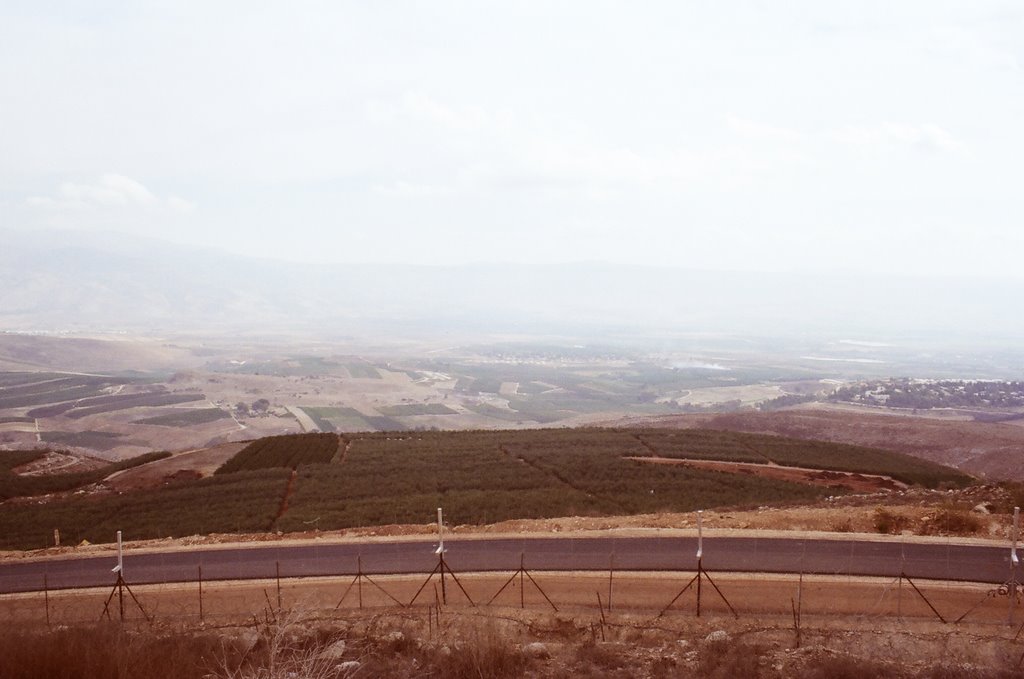
I arrived to meet Ahmad after a high emotionally-charged trip through the destroyed villages along the Israel-Lebanese border. We stood there silently sobbing watching the forbidden land that we consider Palestine as we puffed our cigarettes along with our frustration and helplessness. On one side of the border total destruction, burnt land and graffiti of resistance; and on the other side, green fields and tidily arranged houses protected by Israeli military. All look serene rendering the scene more brutal and surreal. Borders never looked more ridiculous and painful, a winding barbed wire with fences and military roads marking the separation, cutting through a land that looks very much alike. A land that is one, a natural continuation divided by a war machine and ruthless bombing. We had to leave quickly; the feeling of helplessness and frustration in the face of such a ridiculous fence and such grave injustice was too intense to bear.

I met Ahmad in his village, Dayr Seryan, in the south of Lebanon while he was playing with his friends around plastic water tanks stacked in front of the village´s school. The tanks were waiting to be distributed part of relief programs and were the source of imagination for the kids game. They were playing war, using the water tanks as shelters, running around throwing little stones at each others then screaming “go to the shelter, go to the shelter” before they run laughing to hide between the lines of grey water tanks and stay still for a while before they storm out and start throwing pebbles again. Even as we sat to talk we were not spared few pebbles and laughs from the crowd inciting us to leave the interview and join the game. Ahmad is 12 years old and he spent 21 days in his village during the war before they left during the 24-hour ceasefire declared by Israel – a ceasefire Ahmad told me was restricted to aerial bombing while the Israeli cannons thundered in the distance. He caught my attention from the first minute, the way he spoke calmly with a smile and much confidence, and the way he stared at the ground and took time to think before he answered. His friends were all around us, teasing him to which he responded with a wide smile and closed eyes as he turned his head down. Ahmad´s father works in Qatar while he lives with his mother and two siblings, an older brother and a 5-year-old sister – in the village.

Where did you stay during the first 21 days of the war? and what do you remember of those days?

We stayed in our house, with our grandparents and our uncles and their families. We played all day as our parents watched the news or listened to the radio. At night there was a lot of noise from the bombs. The noise felt much louder at night and scared us a lot, during the day we could ignore it and play, but at night it was impossible. We also had to turn the lights off so the planes won´t know that there are people inside. I kept telling myself that if things become very dangerous my family will save me, this is how I went to sleep. We heard that some families had no food left, but we had grains and we were taking vegetables from our garden to eat. Sometimes there were people from the Civil Defense delivering bread, and when they did not come due to the bombing my mother would bake some. What scared me the most were the empty streets. It was very scary to look out anytime and not see anyone nor heard any movement. We felt all alone though there were many people in the village. This was the scariest part. My little sister was crying all the time, and we could not do anything to make her stop. Even letting her play with my toys did not work.”

How did you leave the village?

After they bombed the bridge connecting the villages in our area to the north of the country, the people of the village decided to leave during the ceasefire. People started going out of their houses bit by bit. At first I could see few families walking down the streets, then more and more till we became around 400 people walking. Immeh (my mother) told me not to be scared, and that everything would be fine once we leave, I believed her but still I was scared. You could hear the cannons in the background. All through the way I was thinking about what will happen if they start bombing us. It was all over the news that they were bombing caravans of people leaving their villages. I thought they will start bombing us any minute. We leaved at 8 am and walked till a village where we could find cars to take us to Beirut. We walked around 3 hours. There were a lot of people walking with their things, also from other villages. Some people were throwing away things they were carrying because they were getting tired. Some children like my sister were crying, I held Immeh´s hand and tried not to be scared.

What do you think of the UNIFIL?

They are here to protect us. Before they did nothing to protect us, but now they say they will. We will see.

There is a UNIFIL base very close to your village, why did not you go there to hide instead of walking for hours?

We did not want to be the only ones to go there, and the people in the village were scared that Israel might bomb the UNIFIL base if we went there. They did it before in Qana and killed a lot of people. It was much better to go far from Israel.”

You told me you went to Syria after you left the village, how was it there?
I was worried about my grandparents who stayed in Beirut. We were bored in Syria and did not have our toys with us. But it was good because my father met us there and we got to spend time with him though most of the time he was either waiting for the news or trying to phone the family in Beirut.

Did you want to leave the village?

I do not know. I did not think about it. We did not have the choice, and I was scared. Here we were sitting around waiting for the bombs expecting to be hit any time. We had to run away. If I was older I would have helped defend the village, but now I do not know how.

When did you come back, and what can you tell me about it?

We came back to the village few days after the final ceasefire. My parents were anxious to see if our house was destroyed. When we arrived the house was still there, but we were told that the Israeli soldiers stayed in it during the few days they occupied the village. A lot of furniture were broken, and there were a lot of mattresses on the floor and a bit of the food they left behind. We were scared that they might come back, it felt like the house smelled of them. My mother was crying when we entered, she thought we would never come back to see it standing. They threw our year-stock of grains on the floor, mixed all different kinds in a pile then poured oil on it. We had to throw it all. Immeh was very upset about that.

Why do you think they did it?

I do not know. I think to hurt and scare us. But maybe ask them, why did they kill all those children. It is very easy, give us our prisoners and let them take theirs, without the war.

Do you think they will start another war? and if so, what to do?

I do not know, but they will come back for their soldiers. We have to let them go anyway; but after they free our prisoners in Israeli jails. I do not like war and it scares me; but I feel for the prisoners, poor them we have to free them. Israel has been detaining them and torturing them for such a long time. If they start a war again, we have to protect ourselves, we have to support the resistance... they are the only ones defending the village.

Do you have any message to the world?
(smiles shyly) I do not know.

And to the resistance?
May god protect them, and grant them victory.

Do you think we won this war?
We stopped them this time, but maybe they will come back. There were a lot of destroyed houses and a lot of people died; they are all martyrs. The prisoners are still in jail; poor them. I do not know, yes I think we won.

Ahmad´s friends were getting restless around us, giggling and teasing him by chanting “Ahmad, the martyr”. He looked to the ground and smiled shyly - I left him at that point. There was nothing more I wanted to know, or could bear to ask. It was becoming harder for me to fake strength in front of his, holding back my tears was choking me in front of his words of defiance and the calmness of his voice. I did not live this past war, and did not feel entitled to break down in front of him while he held together so beautifully. I thanked him, and he ran to join his friends in throwing pebbles at me before they ran to hide behind the water tanks shouting to me to come to the shelter... I walked away towards the car. In Ahmad´s village there is not a single bomb shelter, a village contaminated with cluster bombs, few kilometers away from the Israeli – Lebanese border, few kilometers away from a green land packed with beautiful houses with red-brick roofs and lots of bomb shelters – those are Israeli settlements.

Photos by Sandy Chamoun, Big thank you, to Ahmad and his friends as well!

Stop "Autumn Clouds" from killing civilians in Gaza! ACT NOW!

The Israeli military is engaging in an continuous offensive in Gaza, which resulted so far in more than 300 injured, and more than 70 killed - mostly civilians. Please take action urgently to stop this madness named by the Israeli military “Operation Autumn Clouds”.

I just came from a candle vigil at the mass graveyard of the victims of the Sabra and Shatila massacre. The pain is unbelievable, it is the same story again and again with the civilian toll rising. More actions are planned in Lebanon in solidarity with the people of Palestine and those being massacred in Gaza. I do not know what to say... I chose to post an account from Beit Hanoun... please read on...

Appeal from the people of Beit Hanoun -
click here


The Massacre of Beit Hanoun

From Electronic Intifada, Yousef Alhelou writing from Beit Hanoun, occupied Gaza Strip, 8 November 2006

One day after the Israel army declared that it had pulled out and completed Operation Autumn Clouds in the northern Gaza Strip town of Beit Hanoun, 24 Palestinians were killed in Gaza and the West Bank, 19 people were killed and at least 45 were injured as a large number of shells were fired at the town. Another five Palestinians were killed in Jenin, northern West Bank by Israeli army fire.

The series of incidents began at 6 a.m., when eyewitness said that dozens of tank shells and missiles landed simultaneously in a small and limited area in Beit Hanoun. Ambulances found it difficult to evacuate the wounded. According to Palestinian sources, some of the shells landed on a house, killing 11 members of one family called Al-A'athamein, including a nine-year-old child and a 73-year-old woman. Israeli sources confirmed that artillery shells were fired Wednesday morning. Incredibly, they said it was not yet known whether the matter was a technical error or a human one.

Sources in Gaza reported that some of those killed were hurt after shells hit a group of civilians who arrived to aid those hurt in the first barrage. Residents in the area were called to donate blood for fear that the number of casualties would be higher. Khaled Radi, a Palestinian Health Ministry official, said all the dead were civilians. He said seven children and four women were among the dead.

Radi also said at least 45 more were wounded, all civilians. Four hospitals are treating the wounded across Gaza. Emergency and first aid director in the ministry of health, Dr Moa'aweyah Hasanein announced that the latest round of Israeli war crimes in Gaza has resulted in a new massacre in the northern town of Beit Hanoun. Nineteen innocent civilians, including seven children and four women, have been murdered brutally as they slept in their own house. This brings this week's toll alone to around 80 Palestinian martyrs and more than 350 have been injured.

In a huge demonstration outside the morgue at the Kamal Adwan hospital in the northern Gaza Strip, thousands called for revenge. Hundreds of Palestinians began marching in the northern Gaza Strip, in protest of the IOF operation in Beit Hanoun. The protestors chanted slogans against Israel and demanded revenge.

President Mahmoud Abbas declared a three-day mourning period, closing schools after the horrific massacres against civilians in Beit Hanoun northern Gaza. "This is a horrible, ugly massacre committed by the occupation against our children, our women and elderly in Beit Hanoun," he said in a statement. "We urge and call the Security Council to convene immediately to stop the massacres committed against our people and to uphold their responsibility to stop these massacres." During an emergency meeting of the Palestinian cabinet, PA Prime Minister Ismail Haniyeh announced that efforts to form a national unity government have been suspended after "this awful massacre."

The labor syndicate in Gaza called today for general strike and to urged citizens to visit the families of the victims and wounded people in hospitals. The government spokesman, Ghazi Hamad, appealed to the international community to mobilize and stop Israel from carrying out such massacres against unarmed Palestinians. " Israel is a nation that has no human values and is a disgrace to the modern world," he said.

Palestinian Health Minister Bassem Naim referred to the trend of similar incidents, saying that killing constitutes a policy and a target for the Israelis. He stated, "I have no words to describe the ugly Israeli massacre in Beit Hanoun this morning." According to Naim, "This massacre is added to another massacre which the town has only just emerged from. This morning's operation only proves that killing is Israel's target, and this is proved by the massive fire at the medical teams arriving at the area." Naim added that more proof was the inclusion into the Israeli government Avigdor Lieberman, who openly calls for the killing Palestinians.

"The massacre in Beit Hanoun proves that the Israeli government is committing war crimes against civilians," said Israeli Knesset member Talab El-Sana after the incident. "Palestinian children and women are murdered in their homes and in their beds. Olmert, Peretz and Halutz are war criminals who failed the first war and are committing war crimes in the second war." He called for "the end of the ongoing slaughter" and said "tanks cannot kill the dream of a people aspiring to independence and freedom."

Mohamed A'athamnah, 37, said, "The Israeli army claims that they pulled out from our town. They are not physically here but their smells and their bad image still here, they continue their brutal, horrific massacres against civilians in Beit Hanoun and in all the Palestinian territories. They want to achieve victory here after they were defeated in south Lebanon. They only understand the language of force. They are vampires who don't know mercy; the bodies of children scattered everywhere in the site ... God be with us, the whole world turns a blind eye."

"It is the saddest scene and images I have ever seen," 29-year-old Majed Kafarnah said. "I saw people coming out of a house covered in blood. I started screaming to wake up the neighbors." Mona Al-Zanoiun, 41, said, "They destroyed the houses above our houses, killed women and children; they are criminals, they murder us in cold blood. Where is the international community and Security Council to see these massacres? We do not want them to send us food; we want them to take brave actions to stop these crimes." She described what happened to the town as akin to a tsunami and destructive earthquake.

Nidal Mater, 53, said, "Once again they commit massacres against civilians, but they will not break our sprit. We will not leave our land; all of us are ready to die for the sake of freedom." He added, "they use their arsenal to kill children and women. They are cowards; hatred has been engraved in our hearts and we will never forget. Where is their democracy? I wonder, are they just human beings like us? They destroy our agriculture fields, water, electricity networks and infrastructure -- we cannot recognize our streets. Destruction is everywhere, even mosques, which are considered holy places, destroyed!"

Noor Masoud, 14, stated, "My message to the Israeli army is, well done -- every day you prove to us that you are the most polite army of the world." She was crying when she spoke and added, "If you ask the trees and walls in Beit Hanoun they will tell you how merciful the Israeli army is! It's so funny when the Israeli government expresses its regret following this horrific, awful massacre."

Mahmoud Nasser, 33, said, "We rush from one mourning tent to the other because of the operation that only ended yesterday and already we have to deal with a new massacre. Difficult images, dead children, injured children with their faces torn. It's unbelievable." There was an ugly scene in the town's hospital as well, where mothers cried out as they carried their injured children. He added that all of Beit Hanoun "is busy with only one thing, moving the dead and wounded. All this between puddles of blood, lots of blood and body parts, next to some of the bodies were the schoolbags and sandwiches of children preparing to go to school."

Um Zeyad, 42, said that she had lost four of her children in the incident: Muhand, Mahadi, Arafat and Saad. "I am proud to be the mother of the Shahids [martyrs]; it is a great honor and we pray to Allah to compensate us," the bereaved mother said. She added two days ago "the Israeli army stole $1800 from my sister's house; another woman in the same house tried to prevent him from stealing the money, but he hit her by this gun to her head and she lost consciousness. The soldier refused to allow a woman to bring water, 42 of us were women and children trapped in one room."

I asked a man about what had happened and he started crying. Another man said, "It's normal to see a woman cry but it's very hard to see a man cry." He added, "We lost our houses, family members, loved ones and they destroyed our agricultural fields, citrus trees and olive trees, which are our only income. Today Palestinians united against one enemy."

Yousef Alhelou is a freelance Palestinian journalist. He can be contacted at ydamadan@hotmail.com.

Sunday, November 05, 2006

When Rain Becomes the Nightmare: National Day Against Cluster Bombs!

When it comes to cluster bombs, rain was again an issue; a big tent was put up in Martyr´s square in downtown Beirut to host the event to avoid the pouring sky. Many NGOs, local and international, gathered to raise awareness about this indiscriminate weapon and to voice a demand for a ban on its manufacturing, distribution and usage. School children and adults toured the multiple sections of the event, an extensive photo exhibit revealing the perilous impact of these weapons in Southern Lebanon; a booth and area where specialists illustrated the stages in constructing prosthetics and artificial limbs, and where the public could also try them along with wheel chairs; a puppet show for children raising awareness amongst the children; a musical concert by handicapped children; a re-production of a contaminated zone and a display of the different types of cluster munitions coupled with demining demonstrations; an exhibit of products and crafts made by Lebanese victims of landmines. The event included signing a petition (sign online) against the production, trade, stockpiling, and use of cluster munitions.

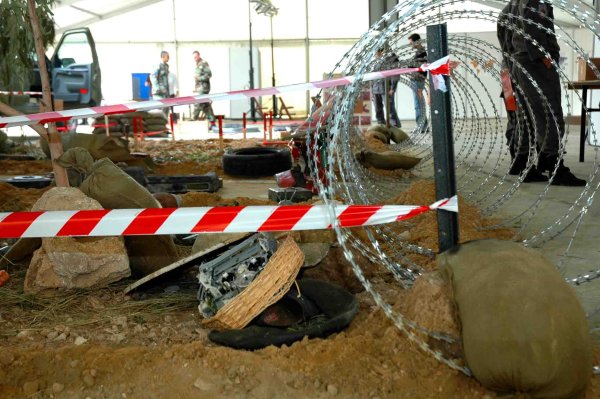
The day was intense and very charged especially around the center of the tent where a re-production of a contaminated field was displayed. The display included a small tree branch with a cluster bomb hanging from it – a fraction of a scene reminding of more than a million unexploded munitions scattered around the south of Lebanon. A double crime according to Ms. Karine Gavand, Handicap International (HI) Project Manager for the National Day Against Cluster Munition. “They have to be banned, cluster munitions are a double crime. First during the conflict where they cover wide areas mostly civilian ones; and later after the ceasefire where they continue to kill civilians and have serious impacts not only on civilian lives but also high social and economical ones. Farmers cannot reach their fields, and they will not be able to plant the next year´s harvest. The scary thing is that a lot of people in the south live from agriculture and they need to go back, even if they are aware of the danger. If they cannot eat they will go even if it means risking their lives since for some it is the only income not just for this year, but for the year to come.”

HI Director of Mobilization and Political Action, Mr. Jean Marc Boivin, said “ we found out that 98% of the victims of cluster munitions are civilians with a third of that under the age of 18. Since the cease fire on August 14th, we have 158 civilian victims with twenty dead. Cluster bombs are a serious problem that can go on for years.” Mr. Boivin is working through HI alongside a wide range of international bodies to push for a ban on cluster munitions, something he said he is not willing to compromise. “We have to ban them, they are indiscriminate and their deadly effect can continue for years. Everyone should be pushing their governments to put a ban on such weapons. We get all kinds of excuses from governments against banning them, they are all unacceptable. Belgium is a good example - though the only one; a ban on cluster munitions came in action in Belgium despite the strong lobby of factories making them and businesses benefiting from the distribution. In France we managed to collect 300,000 signatures demanding the ban, and we called presidential candidates to ask them what position would they take in case they won. They all said they would support a ban except for candidate Nicolas Sarkozy.”

Ms. Gavand said that cluster munitions continue to be a problem in countries like Afghanistan, Iraq, and Kosovo – to name a few, and even in Laos more than 30 years after their usage by US forces. Usually cluster munitions have a failure rate between 5 and 30 % but in Lebanon it was as high as 40. Ms. Gavand linked this among other reasons to Lebanese soil since the softer the soil is the less the chances are for these bombs to explode immediately. She also spoke of the way they were used by Israel by being launched too low adding “we do not know if this was intentional or not, but it must have contributed to the high failure rate.” She also spoke of Israel using outdated bombs going as back as the seventies, something supported by multiple reports from international investigations of the contaminated areas, and visible in the photos of the cluster-bomb shells in the exhibition in Beirut. She expressed deep concern over the rain season; “marked contaminated areas will be wiped out by the rain affecting all the mapping done, and cluster munitions will be moved from place, let alone be covered by mud and hidden away. All this will make cleaning the areas much harder adding to a lengthy, costly and slow process – all of which will have serious impacts on civilians in the area. The rain most probably will affect the agreed upon due-date for finishing the cleaning which is set for the end of 2007.”

Mr. Boivin stressed all through the interview on the urgency of banning such weapons; he mentioned scary stocks of sub-munitions worldwide going as high as 800 million bomblets only with the USA. He spoke of the international network working for a ban on cluster bombs, and especially in Europe. Yet these efforts, according to Mr. Boivine, are faced with a strong lobby of arms manufacturers supported by various governments, some of which still did not sign the Ottawa treaty banning landmines. He extended responsibility to businesses investing in factories of cluster bombs, and gave an example AXA, a worldwide banking and insurance group which was found to be investing in companies such as Textron and ATK who are known to be manufacturing these indiscriminate weapons.

Victims of cluster munitions in Lebanon, according to Ms. Gavand, do not only suffer serious injuries such as amputations, but also suffer shrapnels all over their bodies – a nightmare made clear in the photos displayed through out the event courtesy of the Norwegian People´s Aid. Photos that showed boxes piled with cluster bombs, contaminated fields with sheep and shepherds walking around, amputated victims, children with shrapnels going as deep as their lungs, cluster bombs in house vicinities, and even a bloodied stretcher used to transport an injured civilian. The images are so strong that no words can describe them, yet this is only a still reproduction of a much more horrid reality.

I spoke to Mr. Imad Khoshman from Al-Jarha Foundation, himself a victim of Israeli war on Lebanon in 1986 leaving him with an amputated leg. Al-Jarha Foundation (Al-Jarha translates into the injured) takes care of victims of the Israeli war on Lebanon from physical rehabilitation to vocational training among other concerns. Mr. Khoshman, also an activist for handicapped rights in Lebanon and participant in many national platforms for this plight, spoke of the lack of attention from the Lebanese government towards the handicapped. “We have noticed that their priorities do not include our rights despite them being inherent and urgent” said Mr. Khoshman, “we have been pushing for the application of law 220/2000 that secure a step towards equality and integration for the handicapped whether war victims or not since 2000, yet unfortunately the government only complied with the littlest of the little.” Mr. Khoshman stressed the importance of raising awareness around cluster bombs, and also the urgency of the clearance. He said “I urge the international community not only to ban cluster munitions, but to extend financial and professional aid to the Lebanese government and the NGOs working on the issue. Also I urge the Lebanese government and the international community to give attention to the plight of the handicapped, and bear responsibility of the victims of cluster munitions and war.”

The event in Beirut is hoped to be a launch for many to come in various Lebanese areas in an attempt to raise awareness around the issue of cluster munitions in a hope to undermine to a certain extent the associated risks. But will it be enough to save the lives and the welfare of the people is the big question. It definitely will with the visible bomblets, but there lies the danger of the hidden ones, those tucked under stones or covered with mud. Ms. Gavand said that though she saw quite a lot of pictures of clusters before heading to the south on a field trip, it still took her few minutes to visually locate one tucked away in dry branches though it was pointed out to her by one of the demining experts. Those few minutes that are more than enough to cost a person her or his life are another call for a total ban on this weapon. Awareness is indispensable and life-saving but is not enough - as much as demining and cleaning the contaminated areas are vital and a matter of life or death – yet it is still possible for some bomblets to escape expert hands especially with factors such as rain and the wide spread of the bomblets. This is what renders a ban on cluster bombs the most efficient way in terminating the danger of such indiscriminate weapons. Everyone I talked to at the event today had one message to the world, “ban it!”. More voices are needed and definitely more action against this outrageous crime. The toll is very high; it has been for a while and the horrid reality is that it will be on the rise for a long time.

According to the press release, the event in Beirut is also meant to “send a message to the international community prior to the Review Conference of the Convention on Certain Conventional Weapons in Geneva, taking place from November 7 – 17.” A conference according to Mr. Boivin which is not meant to tackle the ban on cluster munitions but rather discuss the post-usage of such weapons which is by no way a solution, yet it poses a good opportunity for NGOs and groups working on the issue to coordinate and call for another international gathering to lay the foundations for a ban on the production, trade, stockpiling, and use of cluster munitions. How long will we have to wait? How high will the price be till the governments of the world reach such an urgent agreement? It is all in their hands, and ours. Act today!

Fotos by: Elsee Haddad

Thursday, November 02, 2006

UNIFIL... out and about!

On the 15th of March, 1978 the Lebanese government submitted a complaint to the Security Council against the Israeli invasion and occupation of the entire southern part of the country except for the city of Tyre and its surrounding area. As a result, the Security Council adopted resolution 425 and 426 in which it called upon Israel to immediately cease its military action and withdraw its forces from all Lebanese territory; and decided on the immediate establishment of the United Nations Interim Force in Lebanon (UNIFIL) whose troops arrived in the area on the 23rd of March 1978.

According to the Security Council, the interim force was created for three purposes: Confirming the withdrawal of Israeli forces, restoring international peace and security, and assisting the government of Lebanon in ensuring the return of its effective authority in the area. UNIFIL claims success of the implementation of two of the objectives; confirming the withdrawal of Israel – which is not true since Israel holds military presence in the Lebanese Shebaa Farms and recently in the Al Gajar village; and assisting the Lebanese government in regaining control in the area – a role whose credibility and effectiveness are very ambiguous.

Before Security Council resolution 1701 in 2006 that raised UNIFIL presence in Lebanon to 15000 troops, UNIFIL operated with a force consisting of some 1,990 troops assisted by 50 military observers from the UN Truce Supervision Operation (UNTSO) based in Jerusalem and supported by 95 international civilian personnel and 295 local civilian staff. The force till that date included participation from France, China, Ghana, India, Ireland, Italy and Poland; and operated with an annual budget of $ 94.2 million.

The UNIFIL presence in southern Lebanon proved useless in protecting the civilian population from the continuous Israeli attacks. This was obvious especially in the bombing of a UN compound in Qana in 1996 and the UN silence towards this crime. The compound was a concentration point for refugees who fled the heavy Israeli bombing of their villages. Around 800 civilians were present in the UN compound on the 18th of April, 1996 - the day of the shelling that resulted in 106 civilian deaths and 120 seriously injured including 4 Fijian UNIFIL soldiers. Israel claimed that it was responding to Katyusha firing from Hezbollah fighters from that area and that the presence of the civilian population was unknown to them though Lieutenant General Amnon Shahak, Israel´s chief of staff at the time, stated “I don´t see any mistake in judgment... We fought Hezbollah there, and when they fire on us, we will fire on them to defend ourselves... I don´t know any other rules of the game, either for the army or for civilians...”. The investigation conducted by the UN appointed military advisor Major General Franklin van Kappen of the Netherlands stated that “during the shelling there was a perceptible shift in the weight of fire from the mortar site to the United Nations compound.” It was found out in the investigation that “contrary to repeated denials, two Israeli helicopters and a remotely piloted vehicle were present in the Qana area at the time of the shelling” concluding that “while the possibility cannot be ruled out completely, it is unlikely that the shelling of the United Nations compound was the result of gross technical and/or procedural errors.” Amnesty International concluded after an on-site investigation in collaboration with military experts and using interviews with UNIFIL staff and civilians in the compound that “the IDF (Israeli Defense Forces) intentionally attacked the UN compound, although the motives for doing so remain unclear. The IDF have failed to substantiate their claim that the attack was a mistake. Even if they were to do so they would still bear responsibility for killing so many civilians by taking the risk to launch an attack so close to the UN compound.” Despite all the investigations and the incriminating evidences against Israel, it was not held accountable beyond diplomatic condemnation. It is worth mentioning that Qana was once again targeted by Israeli army, among other villages, during this year´s Israeli war on Lebanon where Isaeli air strikes tumbled down a three-story residential building hiding refugees from nearby villages fleeing the Israeli war machine, leaving 28 civilian deaths out of which16 were children. According to the statement of the International Red Cross, the continuous Israeli bombing of the road to Qana hindered the rescue work; while Human Rights Watch reported that “... none of the dozens of international journalists, rescue workers and international observers who visited Qana on the 30th and 31st reported seeing any evidence of Hezbollah military presence in or around the home. Rescue workers recovered no bodies of apparent Hezbollah fighters from inside or near the building.” This Israeli massacre, as the rest, received almost no accountability beyond diplomatic scolding. On the contrary, the discourse of the United Nations, in the person of its Secretary-General Kofi Annan, stressed on the disarming of Hezbollah with a shy condemnation to Israel.

During the 28-year presence of the UNIFIL in the south of Lebanon, Israel did not once respond to any UN demands in holding back its war machine, nor in responsding to Security Council resolution 425 – still no measures were taken against it. Later this year, during the recent Israeli war on Lebanon, UN posts and personnel were repeatedly targeted by the Israeli army resulting in 4 deaths of UN military personnel from Finland, China, Austria and Canada, 2 deaths within the UN civilian personnel from India, and 12 wounded. In a briefing on 26th of July, 2006, Ms. Jane Holl Lute, assistant secretary general for the peacekeeping operations stated that “...events unfolded as follows... Patrol Base Khiyam, a long-established and clearly-marked UN position in the eastern section of UNIFIL´s area of operation... came under recurrent incidents of close firing.” The briefing explained that “UNIFIL reported that, in total 21 strikes occurred within 300 meters of the Patrol Base and 12 artillery rounds fell within 100 meters of the Base, four of which hit the Base directly. To our knowledge, unlike in the vicinity of our other Patrol Bases, Hezbollah firing was not taking place within the immediate vicinity of the Patrol Base.” According to the report, UNIFIL protested directly to the Israeli army each of these incidents of firing close to the base; and that the Deputy Secretary-General and Ms. Lute made several calls to the Permanent Mission of Israel to the United Nations reiterating these protests and calling for an abatement of the shelling. The UNIFIL confirms two final firings close to the base before communication with the position was lost. As a result of the direct attack the four UN military observers were killed. Other incidents of firing close to the UNIFIL positions were mentioned in Ms. Lute´s briefing and in the accounts of UNIFIL personnel present in the area. UNIFIL has reported, according to Ms. Lute, 145 incidents of “firing close” of which 16 were direct hits on its positions. Several positions sustained more than one direct hit, causing various degrees of damage to buildings, equipment and vehicles. UNIFIL also reported that Israeli artillery rounds impacted approximately 10 meters from its Headquarters compound in Naqoura. Nor UNIFIL nor the UN took any measure to hold Israel accountable for any of these incidents, nor for the almost total destruction of tens of Lebanese villages and heavy targeting of hundreds of civilian areas through out the country; of course nor for its direct responsibility for the 1191 civilian deaths, 4407 civilian injuries, a million displaced, around 10,000 tons of fuel oil spilled in the Mediterranean, severe damage to the infrastructure and a left-over of hundreds of thousands of unexploded cluster bombs scattered in residential areas and agricultural fields.

Despite of all what was mentioned above, resolution 1701 instated a zone extending between the previously set Blue Line and the Litani river in Lebanon free of “any armed personnel”, meaning the Israeli army and Hezbollah since both the Lebanese Army and the UNIFIL forces are armed and present in this zone. Though Israel is responsible for atrocities against humanity and the environment, the United Nations failed to put any restrictions nor blame on it. The establishment of the zone free from any armed personnel on the Lebanese side poses a clear biased stand in support of the demands of the Israeli war machine in putting the full blame on the Lebanese resistance represented by Hezbollah. This did not take into account international and local voices calling for the halt of Israeli aggression against Lebanon continuing since 1978, nor the numerous international and local human and environmental rights organizations and activists that held Israel accountable for numerous crimes against humanity and for intentional ecological devastation. Resolution 1701 ignores, apparently deliberately, the investigations held not only by the United Nations itself, but also independent investigations conducted by international celebrity organizations like Human Rights Watch, Greenpeace, and Amnesty International - only to name a few – which held Israel accountable of serious violations on many levels, some irreversible. The 1701 equates between an act of invasion and aggravated damage to the Lebanese infrastructure, environment, and population both Lebanese and Palestinian, with the legitimate response and (in-comparison to Israel´s military power) microscopic military power of Hezbollah. All this, raise a big question mark on the UNIFIL presence in Lebanon and their hidden agenda. It is clear that they are not here to halt Israel, and without a halt to Israeli terrorism there is no solution in the region... so what are they here for?

Soon, Lebanese and Palestinian grassroots activists reflect on the UNIFIL presence in Lebanon. Stay posted.